Brandywine Creek Watershed Study

Share Brandywine Creek Watershed Study on Facebook Share Brandywine Creek Watershed Study on X (formerly Twitter) Share Brandywine Creek Watershed Study on Linkedin Email Brandywine Creek Watershed Study link

Project Description

The City Administration is requesting a comprehensive update to the Brandywine Creek Watershed drainage study to better understand and identify existing local flooding and stormwater issues. This will help prioritize future capital improvement projects within the watershed. The original study, completed in 2019 with the Northeast Ohio Regional Sewer District (NEORSD), focused primarily on larger, regional stormwater system components, with minimal analysis of smaller pipe and stream networks.

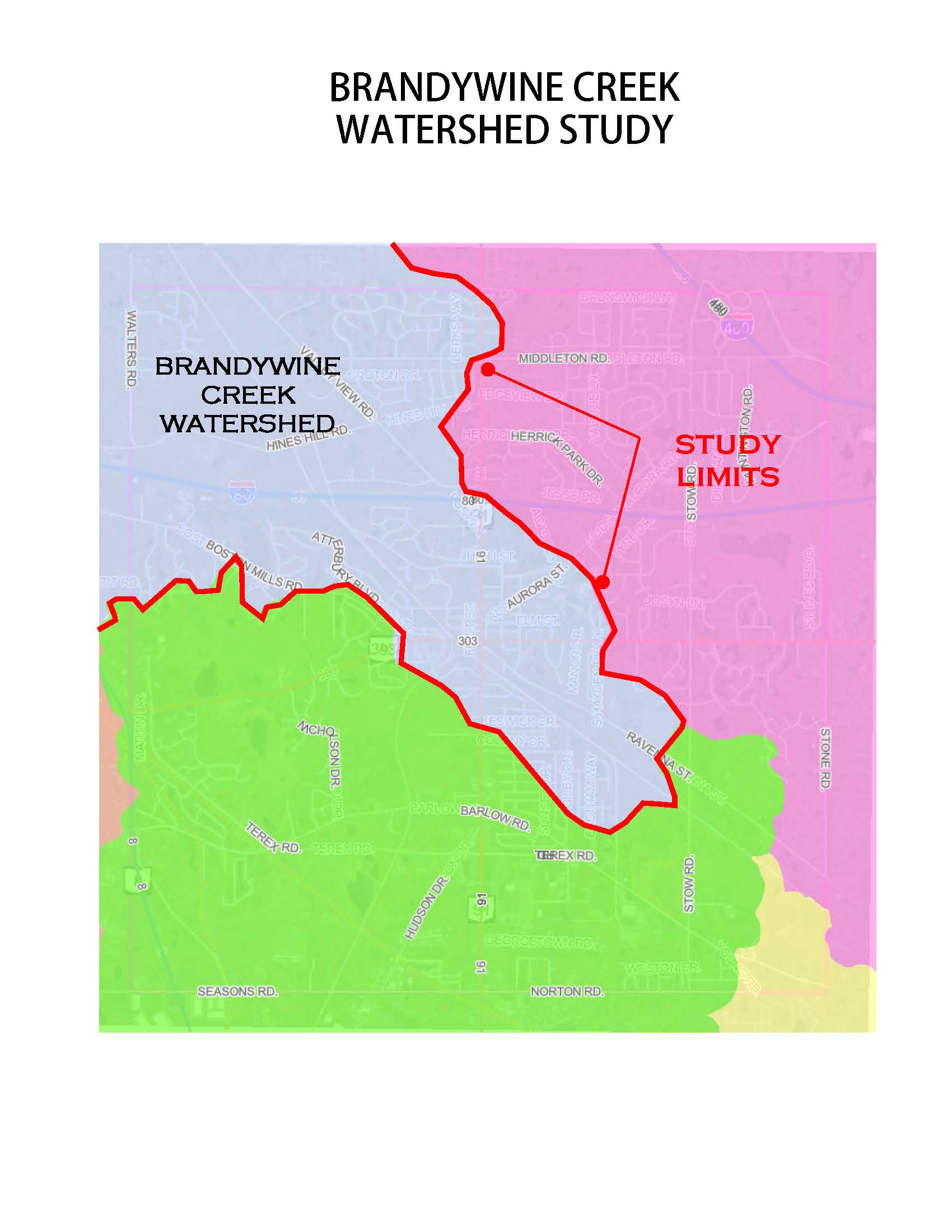
Since 2019, the City has finished several capital improvement projects to mitigate flooding, including improvements at the Barlow Community Center Lake Dams. Additional projects from the 2019 study are currently in design and planned for future construction. Given the flooding on August 8, 2024, limits of the 2019 study and the recently completed projects, an updated and expanded study is warranted. See map attached showing the overall watershed, limits of 2019 study and anticipated study expansion areas.

This study will evaluate the Brandywine Creek Tributary watershed's stormwater system, including major streams, bridges, culverts, and trunk storm sewer mains (18 inches and larger) located within its drainage area. We will catalog existing stormwater infrastructure, generate a new hydrologic and hydraulic model, and then develop and rank alternative solutions to mitigate identified flooding problems and improve water quality. The findings will then be compiled into a stormwater master plan, presented to Council, and used for future capital improvement project planning and budgeting.


Public Input

We want to hear from you! The City is holding its first public open house for the Watershed Study to gather resident input on previous flooding events, which is critical for our data collection and model calibration efforts. City staff and our consultant will present the model's construction to date, discuss its goals, and answer your questions. You can also submit comments online via this website through February 4, 2026. A second public meeting will be scheduled later to present potential solutions for mitigating future flooding.


Public Input Meeting – June 18, 2026

A public meeting will be held on Thursday, June 18, 2026 from 5:30 p.m. to 7:30 p.m. at Hudson High School Auditorium (2500 Hudson-Aurora Road), to receive public input.


What to Expect at the Public Meeting

At the upcoming public meeting, the City's engineering consultant will present an overview of an ongoing study focused on improving the Brandywine Creek Watershed. The presentation will cover the study's purpose: evaluating existing drainage problems and developing solutions to prevent future flooding. The consultant will explain the methodology, including how hydraulic modeling is used to simulate storm events and identify areas where the current infrastructure is undersized.

City and consultant staff will be available to discuss study findings, show maps and data that highlight specific problem areas like frequently flooded streets, and answer questions. For this initial meeting, the City will only introduce potential solutions currently under evaluation.

Following this meeting, staff will summarize public feedback and present the findings to Hudson City Council. The City will then update its recommendations before holding a second public meeting to get more input, ultimately finalizing the study and its recommendations.


Interactive Map Comments

Can't attend the public meeting? We welcome your comments online. Click on the Interactive Map, drop your pin, answer the questions, and click "enter" and your pin with comments will be displayed on the map.

Or, you may complete the Survey Section below.

Comments will be accepted through February 4, 2026.

Questions

Have questions? Click on the Questions tab below to ask a question and we will get back to you with a response, or email Engineering@hudson.oh.us.

Project Description

The City Administration is requesting a comprehensive update to the Brandywine Creek Watershed drainage study to better understand and identify existing local flooding and stormwater issues. This will help prioritize future capital improvement projects within the watershed. The original study, completed in 2019 with the Northeast Ohio Regional Sewer District (NEORSD), focused primarily on larger, regional stormwater system components, with minimal analysis of smaller pipe and stream networks.

Since 2019, the City has finished several capital improvement projects to mitigate flooding, including improvements at the Barlow Community Center Lake Dams. Additional projects from the 2019 study are currently in design and planned for future construction. Given the flooding on August 8, 2024, limits of the 2019 study and the recently completed projects, an updated and expanded study is warranted. See map attached showing the overall watershed, limits of 2019 study and anticipated study expansion areas.

This study will evaluate the Brandywine Creek Tributary watershed's stormwater system, including major streams, bridges, culverts, and trunk storm sewer mains (18 inches and larger) located within its drainage area. We will catalog existing stormwater infrastructure, generate a new hydrologic and hydraulic model, and then develop and rank alternative solutions to mitigate identified flooding problems and improve water quality. The findings will then be compiled into a stormwater master plan, presented to Council, and used for future capital improvement project planning and budgeting.


Public Input

We want to hear from you! The City is holding its first public open house for the Watershed Study to gather resident input on previous flooding events, which is critical for our data collection and model calibration efforts. City staff and our consultant will present the model's construction to date, discuss its goals, and answer your questions. You can also submit comments online via this website through February 4, 2026. A second public meeting will be scheduled later to present potential solutions for mitigating future flooding.


Public Input Meeting – June 18, 2026

A public meeting will be held on Thursday, June 18, 2026 from 5:30 p.m. to 7:30 p.m. at Hudson High School Auditorium (2500 Hudson-Aurora Road), to receive public input.


What to Expect at the Public Meeting

At the upcoming public meeting, the City's engineering consultant will present an overview of an ongoing study focused on improving the Brandywine Creek Watershed. The presentation will cover the study's purpose: evaluating existing drainage problems and developing solutions to prevent future flooding. The consultant will explain the methodology, including how hydraulic modeling is used to simulate storm events and identify areas where the current infrastructure is undersized.

City and consultant staff will be available to discuss study findings, show maps and data that highlight specific problem areas like frequently flooded streets, and answer questions. For this initial meeting, the City will only introduce potential solutions currently under evaluation.

Following this meeting, staff will summarize public feedback and present the findings to Hudson City Council. The City will then update its recommendations before holding a second public meeting to get more input, ultimately finalizing the study and its recommendations.


Interactive Map Comments

Can't attend the public meeting? We welcome your comments online. Click on the Interactive Map, drop your pin, answer the questions, and click "enter" and your pin with comments will be displayed on the map.

Or, you may complete the Survey Section below.

Comments will be accepted through February 4, 2026.

Questions

Have questions? Click on the Questions tab below to ask a question and we will get back to you with a response, or email Engineering@hudson.oh.us.

Ask your Questions and Offer Comments

Have a question? Leave your question here and we will ge back to you with a response.

You need to be signed in to add your question.

  • Share What drinking water supply does this watershed impact? Are there more thorough tests done for toxins due to proximity to the former Krejci dump? What are the results? on Facebook Share What drinking water supply does this watershed impact? Are there more thorough tests done for toxins due to proximity to the former Krejci dump? What are the results? on X (formerly Twitter) Share What drinking water supply does this watershed impact? Are there more thorough tests done for toxins due to proximity to the former Krejci dump? What are the results? on Linkedin Email What drinking water supply does this watershed impact? Are there more thorough tests done for toxins due to proximity to the former Krejci dump? What are the results? link

    What drinking water supply does this watershed impact? Are there more thorough tests done for toxins due to proximity to the former Krejci dump? What are the results?

    Kz1293 asked 5 months ago

    The Brandywine Creek Storm Water Update Study focuses on storm water runoff and its impacts to the capacity of the storm sewer network including pipes, culverts and streams inside the City of Hudson.  The study is not analyzing drinking water resources.  A brief internet search of the “former Krejci dump” reveals that this site is located outside of the City of Hudson and is managed by the National Parks Service.    The City of Hudson has no testing information for this site.

  • Share How does this study fit into the NFIP and FEMA? on Facebook Share How does this study fit into the NFIP and FEMA? on X (formerly Twitter) Share How does this study fit into the NFIP and FEMA? on Linkedin Email How does this study fit into the NFIP and FEMA? link

    How does this study fit into the NFIP and FEMA?

    wfbartz asked 24 days ago

    While this study will not immediately alter current FEMA flood mapping, the developed modeling can be leveraged to update these maps in the future as mitigation projects are implemented and flood risks are reduced. Ultimately, the Brandywine Creek Stormwater Study Update bridges the gap between the high-level mapping produced by FEMA’s National Flood Insurance Program and localized neighborhood flood risks. The study will identify specific engineering solutions—such as larger storm mains and detention basins—to physically mitigate flood risks and prevent property damage. Furthermore, the technical data generated will provide the robust foundation required to apply for FEMA infrastructure grants, while simultaneously aligning with NFIP standards to help lower flood insurance premiums for local residents.