
Tinkers Creek Watershed Study
Tinkers Creek Watershed Study Public Meeting No. 2
Public Input
Public Input Meeting – April 23, 2026
We want to hear from you! A second public meeting is scheduled for Thursday, April 23, from 5:30 p.m. to 7:30 p.m. in the Hudson High School Auditorium, 2500 Hudson Aurora Road, Hudson, Ohio. The second public meeting will begin with a review of the study’s progress, transitioning from the initial data collection phase to the presentation of specific findings. Engineers will highlight the most flood-prone areas and infrastructure bottlenecks—such as undersized culverts and storm sewers—that were identified through hydraulic modeling and resident feedback following the major 2024 storm events.
The focus will then shift to actionable solutions, where the City will present a suite of potential improvements to alleviate severe flooding including infrastructure upgrades, expanded detention basins, and stream stabilization efforts. Following the second public meeting, these projects will then be prioritized into a final Stormwater Master Plan, serving as a direct roadmap for the City’s upcoming capital budget planning to ensure long-term flood mitigation and watershed resilience.
Public Input Meeting – October 23, 2025
A public meeting was held on October 23, 2025 to receive public input. Click here to view the Slideshow Presentation from that meeting. City staff will also present the Preliminary Model to Council at an upcoming Council Workshop in early 2026.
At the October 23 meeting, the City's engineering consultant presented an overview of an ongoing study focused on improving the Tinkers Creek Watershed. The presentation covered the study's purpose: evaluating existing drainage problems and developing solutions to prevent future flooding. The consultant explained the methodology, including how hydraulic modeling is used to simulate storm events and identify areas where the current infrastructure is undersized.
City and consultant staff were available to discuss study findings, show maps and data that highlight specific problem areas like frequently flooded streets, and answer questions. Following the meeting, staff summarized public feedback and presented the findings to Hudson City Council.
*Individuals who previously submitted comments through the City’s door-to-door interview process last summer do not need to provide additional input at the public meeting but are welcome to do so.
Project Description
On August 8, 2024, the City of Hudson experienced a storm that caused significant flooding. There are varying reports regarding rainfall totals based on where you live in Hudson. According to the National Weather Service, on Thursday, August 8, 2024, 6.98 inches of rain fell in Hudson in a 24-hour period, with 6.20 of those inches falling between 6 p.m. and 9 p.m. Some neighborhoods received more rain while others received less. Based on National Oceanic & Atmospheric (NOAA) precipitation frequency estimates, this storm equated to approximately a 500- year event in the hardest-hit areas of Hudson along the easterly portions of the City including neighborhoods that year event in the hardest-hit areas of Hudson along the easterly portions of the City including neighborhoods that drain towards Tinkers Creek. The heavy rainfall strained stormwater systems, leading to flooding throughout northeast Ohio, including the cities of Akron, Cuyahoga Falls, Barberton, Kent, Ravenna, parts of Aurora, Twinsburg, and Hudson.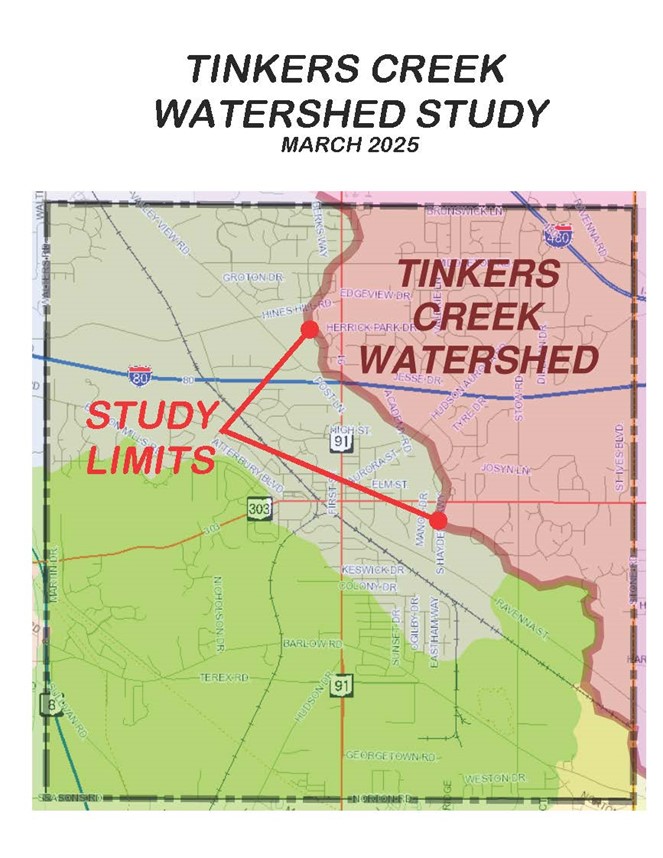
The Tinkers Creek Watershed Study will assess the stormwater system within the Tinkers Creek watershed, focusing on major streams, bridges, culverts, and trunk storm sewer mains. It will also identify stormwater infrastructure elements located within the drainage area that contributes to Tinkers Creek inside the City limits. Additional critical areas throughout the watershed will be reviewed. The study will include a comprehensive inventory of existing stormwater infrastructure, the development of a new hydrologic and hydraulic model, and the formulation and prioritization of alternative solutions to address stormwater flooding issues and enhance water quality. The results will be consolidated into a stormwater master plan, which will be presented to City Council and serve as a foundation for future capital improvement planning and budgeting.
Questions
Have questions? Click on the Questions tab below to ask a question and we will get back to you with a response, or email Engineering@hudson.oh.us.
-
 Tinkers Creek Watershed Study
- What does a “100-year storm” event really mean?
- For comparison, what size rainfall event hit Hudson and the region on August 24, 2024?
- Why does it seem that extreme rain events hit our area more often?
- If the August 8, 2024 storm was one of the worst rain events to cause flooding, why did my property get flooded in other rain events including this spring?
- What is the Tinkers Creek Watershed Study and how will it help my neighborhood?
- How will the City address the severe storm events like what hit the area last August 8, 2024?
- Why is my basement flooding, even though I don't live next to a creek?
- Will the study evaluate sanitary sewer backups into homes?
-
 Tinkers Creek Watershed Flyer (691 KB) (pdf)
-
MS Consultants Slideshow.pdf (13.9 MB) (pdf)
-
Study Area.pdf (344 KB) (pdf)
-
Overall Study Map.pdf (188 MB) (pdf)
-
Public Meeting Presentation 10-23-2025 (3.03 MB) (pdf)
-
Public Input Form (177 KB) (pdf)
-
Tinkers Creek Watershed Meeting 2 Flyer (1.23 MB) (pdf)
-
Tinkers Creek Study Public Meeting 2 Slideshow (2.69 MB) (pdf)

-

Phone 330-342-1770 Email engineering@hudson.oh.us